Category: Human needs

  • A place to feel safe

    A place to feel safe

    WE Modern Humans have in common that we all need a place where we feel safe. A place to feel at home, to relax and to feel human. A home provides a collection of basic needs.

    We Modern Humans have a few basic needs, physically as well as mentally. These needs are reflected in the place where you live or reside and depend on where you are on this earth. Not everybody has access to a bathroom, but still we all have the need to feel clean. A home is often multifunctional, due to the many tasks a human sapiens has to do. All domestic activities take place on a relatively small surface. It’s incredibly soft and comfortable, making it perfect for lounging around the house or running errands.

    To feel safe
    Most of all, a home is a place where one can find shelter. A place where our bodies can be protected from wind, sun and cold weather. As a start this can be quite primitive. A simple roof and a soft spot to rest and sleep are enough for the first few days.

    But soon you will notice that providing for a few other needs around your home would come in handy as well. Take for example access to water and food. Also your sleeping spot could be better, instead of on the ground it could be raised to prevent moisture and little animals from entering. These things should be improved, a bad night’s sleep drains your energy. This is how homo sapiens shapes his home, bit by bit he improves his situation.

    A place to retreat
    We Modern Humans need a place to relax and unwind. A place to think over, a moment to meditate and process emotions.

    Sanitary
    Humans have the need to feel clean and fresh. Although hygiene is not necessarily our number one priority, Modern Humans always searched for a spot to wash and relieve himself.

    Cooking facilities
    The possibility to cook is important to us. The prepared food does not necessarily need to be warm. Some people don’t have the opportunity to eat anything but raw food. Either way, the preparation will be in or nearby one’s home. Globally most people eat warm food. Therefore fire is a minimal need.

    A spot to eat
    Once our food is prepared we seek a spot to sit down and enjoy our food. This is often a moment of ease and to spend time with our family or roommate.

    Heating and cooling
    People always wish to be in a comfortable temperature. Depending on the location of residence, most homes are equipped with a heater or an air conditioner.

    Possessions
    People often store reserves in or around their home. This can be food but also other possessions. Generally we store more stuff than actually needed and we need enough storage space to do so.

    Roof
    A roof above his head is one of the primary needs a human has. A roof keeps warmth or coolness from escaping the residence and it protects all that’s inside against rain, wind and sun.

    Windows and doors
    Humans feel the need to close their home to protect their possessions. But there is also the need to let light in and to air the place. Because of this most homes are equipped with windows and a door.

    What does that mean?
    It is logical and useful to meet your needs in or nearby your home. Though not everyone is capable of doing so.

    Imagine
    A world where everybody can meet his needs in or around his own home. Not everyone has the possibility to create and order his surroundings in such an effective way. It would have quite an impact on the world if all humans would be able to do so.

    How can you improve yourself?
    Be aware that you can save a lot of time, hassle and energy in a well organized home. Make an inventory of what’s lacking in and around your home and think about how to improve this.


    We Modern Humans feel safe
  • Freedom

    Freedom

    WE Modern Humans constantly strive to experience freedom. This need is present all over the world, no matter how much freedom or how many restrictions there are at a certain place.

    Here we come across an essential question: does human Liberty exist and if so, what is it exactly?

    Freedom definition
    To define freedom: basically, people long for the Liberty to be able to do what they want and the freedom of speech. There is also the need not to be alone and this brings us to a paradox. As soon as there is more than one person, we will have to adjust our social level and relinquish a certain Free will.

    This applies mainly when a hierarchy prevails or arises. Freedom is usually seen as the privilege to do what one wants and to not do what one doesn’t want to. These same privileges would be applicable to others and can be on a physical as well as on a spiritual level. Besides this, persons should be allowed to disembosom.

    However, there will always be limitations. This can be because of certain legislations or restrictions in, for example, what you can and may say publically. Some parts of the world are ‘free’, as in that they do not belong to the territory of a state, such as the open sea. But there, the “United Nations Convention on the Law of the Sea” is applicable.

    As you see, you will never be completely free as a modern human being.

    Wherever in the world you are, if you have duties you also have rights. The Free will humans have is described in the rights of human.

    Human rights
    All over the world, Liberty is a central concept in human rights. Free will is described in a large number of meanings and connections. For example, terms such as “freedom to” and “freedom (or indemnity) of” are used.

    It speaks of personal, intellectual, political and academic freedom. The rights of Free will include freedom of conscience, religion, expression and freedom of speech. One is free in choice of faith, parenting style (parental power), work, life partner, etc. Also natural or commercial Liberty are discussed, as well as the adoption of autonomy.

    As you can read, freedom plays a big role in human rights. You could say that the main goal of human rights is to guarantee this Liberty that we long for to the fullest extent possible.

    Freedom and limitations
    As described above, apart from your rights to Liberty, you also have obligations or, in this case, limitations. Examples of this:
    • In the freedom of speech it is not permitted to call for hatred or violence (the prohibition of hate speech).
    • In the Free will of movement, a state may determine whether or not someone is allowed to enter its territory.
    • In the freedom of religion, the government may limit the choice for the place of worship, for the clothing that is worn as a religious expression and the way in which children are raised within a certain faith.
    • In the freedom of dealing with one’s own body (medicine use, drugs, tattoo, mutilation, etc.), a government may intervene if the individual cannot be held accountable.
    • In the Free will of expression, such as art in public places, the government may set limits to preserve public order and morality.

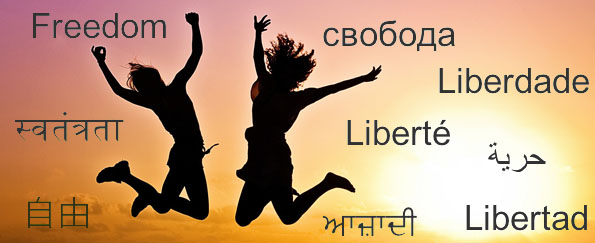
    Below you will find the link to Human Rights in various language areas:
    Human rights in all available languages.

    What does that mean?
    In general we can say that freedom stops at the border of another. Unfortunately, this border can also be a cause for conflicts.

    Imagine
    A world where everyone can be free in his actions while showing respect to another. A world where someone can determine and set his own limits.

    How can you improve yourself?
    As soon as you do not feel free, try to find out where this feeling is coming from. Is it just a feeling or is it a legal or social demarcation? If you cannot live with it, see if there is a place where you can escape this demarcation.
    Generally: imagine how others feel and set limits for yourself. Respect this limit, after all it was your own free choice to set this limit. Be aware which of your personal limits others should not cross and communicate this with the people around you, so they know which limits you have.


    We Modern Humans

  • Our health and a vital body

    Our health and a vital body

    WE Modern Humans wish to have and retain health and a vital body. Achieving good health requires effort and commitment. For example, moving regularly, not overeating, maintaining a varied diet, and getting enough sleep will help you on your way.

    Being healthy is more than just not being sick. It is a state of general well-being in which there is no physical injury or illness.

    You will have to keep up your Well-being (or start getting up). The advantage is that a healthy person feels good and vital. Although doing this does not guarantee a full or lifelong health, an unhealthy life is quite likely to make you (feel) unhealthy. Paying attention to your health will increase the chances of becoming and staying healthier.

    Bad health is related to a lack of satisfaction in your life. It can result in feeling “down” or not experiencing enough love. If you experience these feelings, it is good to check how healthy your lifestyle is. With a healthy body you have the capacity to feel happy and loved, vice versa as well. The focus should be on having a lifestyle as healthy as possible to create a healthy body.

    Bad health is caused by:
    • Overweight
    • Physical addictions
    • Too much sitting down
    • Lack of touch
    • Lack of intimacy

    The Principles of the “Constitution of the World Health Organization” are as follows:

    • Health is a state of complete physical, mental and social well-being and not merely the absence of disease or infirmity.
    • The enjoyment of the highest attainable standard of Well-being is one of the fundamental rights of every human being without distinction of race, religion, political belief, economic or social condition.
    • The Vitality of all peoples is fundamental to the attainment of peace and security and is dependent on the fullest co-operation of individuals and States.
    • The achievement of any State in the promotion and protection of Well-being is of value to all.
    • Unequal development in different countries in the promotion of health and control of diseases, especially communicable disease, is a common danger.
    • Healthy development of the child is of basic importance; the ability to live harmoniously in a changing total environment is essential to such development.
    • The extension to all peoples of the benefits of medical, psychological and related knowledge is essential to the fullest attainment of Vitality.
    • Informed opinion and active co-operation on the part of the public are of the utmost importance in the improvement of the Well-being of the people.
    • Governments have a responsibility for the health of their peoples which can be fulfilled only by the provision of adequate Well-being and social measures.

    Read the principles of the Constitution of the World Health Organization
    English (Also available in various languages)

    Mental health refers to the emotional and psychological well-being of an individual. According to WHO, there is no official definition of mental Vitality. Cultural differences, subjective evaluations and different professional theories make it difficult to determine what “mental health” is.

    What does that mean?
    Paying attention to your Well-being has a positive effect on your well-being and life.

    Imagine
    A world with people that have enough time and resources to improve their health and to keep this up.

    How can you improve yourself?
    Be aware that being healthy or unhealthy can do to you. Make an inventory of the shortcomings
    within your lifestyle (health-wise) and how you can improve that.


    We Modern Humans

  • Our body needs movement

    Our body needs movement

    WE Modern Humans feel the need to move. Our body needs movement and exercise.  We benefit from this: moving is healthy and keeps you fit.

    The way we move depends on where we are and which tasks we perform. In general, you can say that our bodies are made for walking. For us, walking is the most natural way of moving.

    How much movement and exercise is healthy for our body?  Some people go for a walk or walk to a certain destination every single day. Others are regularly found at the gym, are members of a sports club, exercise at home, or seek support from specialized facilities.

    Generally you can say:
    – Moving is good, moving more is better
    – Exercise every week in a moderate or more intensive manner, divided over several days
    – Do some muscle and bone strengthening activities every week
    – Prevent being idle too often (sitting too much can give you a stifling feeling)

    What does that mean?
    For human beings it’s good to move. Our bodies need movement.

    Imagine
    A world where everybody has enough time and space to move or exercise.

    How can you improve yourself?
    Move in a moderate manner to increase your pulse and breathing, while still being able to talk. For example walking, biking, moderate swimming and the bit heavier household chores like cleaning the windows and gardening.
    During intensive activities you will breathe heavier and may even start to pant and puff. Examples of these kind of activities are running, cycling and sports like soccer and hockey.

    – Move at least 5 days a week, 30 minutes a day.
    – Moving strengthens muscles and bones. Improve your condition and feel psychically more fit.
    – Moving reduces the risk of cardiovascular disease, diabetes and psychological problems.
    – You will feel more fit and sleep better.
    – Choose an activity that suits you.
    – When sitting, switch to walking or standing every once in a while.


    We Modern Humans